
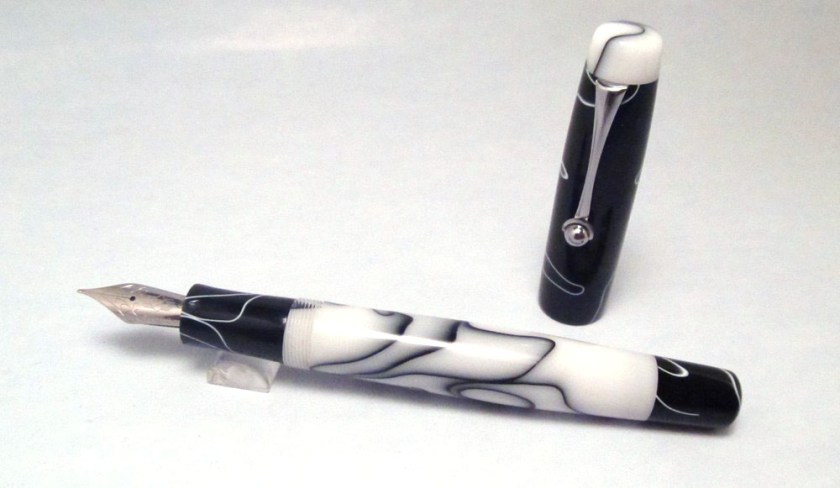
I just got my first custom pen. There are quite a few makers of custom pens out there. But I didn’t just want a pen made from a kit. Those generally all have a similar look and feel—you’re just picking your parts. I wanted something made from scratch. Due in part to my previous dealing with Shawn Newton—I bought a replacement #5 nib from him, which performed beautifully—I went with Newton Pens. And now after a long wait—compared to an off the shelf pen—I finally have my first one of a kind pen.
So what do I think of it?
Design/Ordering Process: 9/10
This was a difficult category to score. The process of designing a pen with Shawn is a fight between two different forces. First, you’re ordering a commercial item. From this perspective the process is kind of lacking. Even if you have a good idea, and you’re idea is fairly simple, it’s probably not going to be as easy as filling in a form, hitting send, and waiting for your pen to arrive. But it’s also—and primarily—a creative process. Working with a craftsman simply can’t be done by visiting a website and checking a few boxes.
To some extent Shawn has tried for a balance between the two forces, and he’s generally opted for the craftsman approach. Our design process took place over about 3 dozen emails over a two week period. When I’m buying a pen I’m not the guy who says, “I would buy this pen if it had this sort of grip”, or “I love this pen except for the color.” Generally I make my decision based on the pen as a whole, unless I’m trying to fill a gap, such as wanting an oversize pen. But when I’m designing my own things I’ll be the first to admit I get a little finicky. Shawn handled this very well, and I appreciated that when he told me something wasn’t doable, that he explained why.
Ultimately, after wasting a lot of his time, I settled on one of his base models, with a custom combination of two materials. If he wanted to jump through the computer and throttle me with my space bar, for taking him on a wild goose chase only to settle on an established model, he never let that show.
If I could recommend a change to the process it would be that Shawn streamline his website to walk the potential customers through the process and their options in a more linear fashion.
Note: I noticed that Shawn has made changes to his website, formalizing certain models, and adding additional information. The score of 9 that I’m giving is based on my experience, not what had changed since then.
Appearance: 10/10
Duh…I designed the pen. Of course I like it. Come to think of it, it doesn’t make sense to judge the pen based on how it looks, because Shawn didn’t choose anything about it’s appearance.
So, instead I think I’ll rate the pen’s…
Accuracy: 10/10
How well did the final product reflect the pen that I thought up? 10 out of 10.
The two materials I chose are decidedly random in their pattern. Whether through chance, or craftsmanship, or a combination of the two, the final product has a nice balance of color and design. The pen could have easily looked silly if the black threads on the white barrel were too few or too many. Though I gave no guidance on how deep the ends of the barrel and cap should be, they both seem “just right”.
In short, the pen looks exactly like I thought it would. Scratch that. The pen looks exactly like I wanted it to look. What’s the difference? I didn’t expect that the pen would look exactly like I thought—how often do you make something and it turns out just right? For me, not often. My guess is that Shawn had better results.
Construction: 10/10
A 10 just doesn’t seem like a high enough score here. There is a fundamental difference between a quality handmade product and a well-made, mass-produced product. I can make a few things by hand, but none of them are well crafted—maybe…MAYBE…well-built.
This pen, is finely crafted. My brain and my eyes KNOW, that this pen is made of two different materials. But my fingers can’t feel any of the seams (not counting the one that’s threaded, because…duh…I can feel where the threads start). If I didn’t design this pen by picking two different materials, I would assume this pen was made from a fancy acrylic that was formed from two different colors—it’s that smooth. The threads…normally I don’t like threads that join plastic to plastic. There’s always a lot of friction, and if not well done can feel scratchy. These are the best plastic to plastic threads I’ve felt—very smooth.
And turning to a more subjective measurement–the pen just FEELS like someone spent a lot of time on it.
Filling: 8/10
8 is my default score for a Cartridge/Converter system, where the end of the section is smooth, making it easy to wipe off after filling. But, as with the appearance, Shawn didn’t pick this. He provides other options, but I went with the Cartridge/Converter because that’s what I like. I’m not scoring this category, either.
Nib: 9/10
The nib wasn’t great at first. It wasn’t quite smooth, and it was awfully wide for a Fine. I discussed this with Shawn through email, and he told me a couple of things I could try. I tried them, and frankly I made things worse. So Shawn told me to send it back to him and he fixed it up for me, even correcting my own poor attempts.
Now it’s a nice, wet Fine. It’s probably the best of the steel nibs I now have, and that means it beats out a Visconti, a Delta, a TWSBI, a Binderized Pelikan, and a Pendleton Pelikan.
Test Drive: 10/10
The whole point of a pen is how it writes. Everything else is prologue. Can I write with the damned thing? Can I write for hours? When I clean out my pens and decide to ink up 3 of them, will my heart reach for the Newton?
It’s not even a fair question. With Shawn’s help I designed a pen that is very much ME. I love this pen. One knock would be that I didn’t realize how light the pen would be…but when I put it on the scale it’s still a little heavier than my Custom 74….so I guess it just looks like it should be heavier.
I haven’t left it uninked since I got it. So far it’s handled Yama-Budo, Visconti Turquoise, and Cactus Fruit Eel without skips, and without any problems.
Overall: 9.6/10
9.6. That’s the verdict. For comparison, my Delta Dolce Vita Piston, and My Visconti Homo Sapiens Bronze both got the same score.
If you’re looking for a custom pen, I cannot give a better recommendation that to give Newton Pens a try.



 We talk a lot about the rituals and habits of writing. It’s the same for just about every blog, website, magazine or class that I’ve had experience with. What time of day should we write? Do you write every day? Do you journal? Don’t edit while you write. Write by hand. Don’t write by hand. Caffeine precedes inspiration. And so on. And so on.


 Written based on the

 Congratulations. You’ve survived a NaNoWriMo November. Not only that, you won. You kept a vigilant eye on that daily goal. And you met–or even exceeded–that goal enough days in the last month that you’ve emerged from the fray with 50,000 words. Now, it’s time to take a look at what you have.
 Where Is My Spot?