Giving Constructive Criticism, Part II

Last week Annie write a very informative post called Giving Constructive Criticism. I certainly hope she didn’t intend it as a multi-part post, because if she did, I’m probably stepping on her toes.

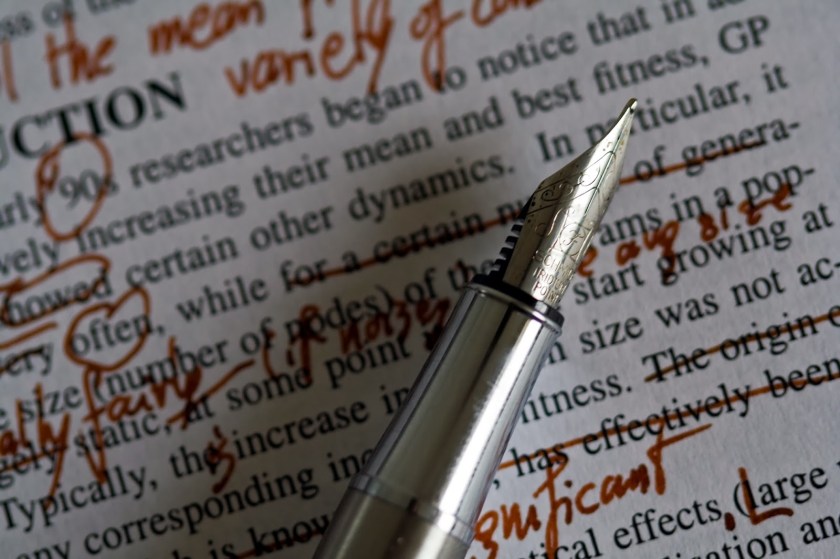
I have two children in middle school, and in English they are focusing a good deal on improving the quality of their writing. And this year their teacher has chosen to include peer review as part of that process. So now my children are learning about critiquing, and it’s not the easiest lesson.

The teacher gave the students a handful of lessons on the different aspects of critiquing. Like Annie she focused on the technical aspects of critiquing—how to make sure your criticism is targeted and helpful. However, in helping my kids critique the work of other students I realized that the teacher’s instruction neglected the emotional side of critiquing—how to make sure your criticism is well received.

There is only one good reason for critiquing the work of another author—to help them improve their writing. In my experience, very few authors understand this.

In my writing career I’ve had many opportunities to have my work looked over by other. Writing classes, writing groups and online writing groups all use peer critiquing as a critical component of their format. But not all participants come to the desk with the proper mindset.

In writing classes, students often attempt to tear down others’ work to make their own look better by comparison. On the other hand, common in writing groups, are drive by authors who are only members long enough to get their own work critiqued. Some have developed rules or point systems to ensure that authors must critique a certain number of stories before submitting their own for discussion, which can, in turn, lead to authors who submit shallow, superficial critiques, just to inflate their numbers.

If you can’t pick up another author’s work with the intent—nee desire—to help them write better, to give them your honest, thoughtful view of their hard work, then don’t critique their work.

But even if you have the right purpose in your heart, it’s still easy to deliver a devastating critique, by giving your advice in a less than constructive manner.

Some guidelines I have found over the years (often through trial and error):

  1. Don’t rush: The author didn’t rush in writing it, so you should give them the same courtesy. If a writer realizes that you spent 15 minutes critiquing a 15 page story, they’re likely to feel cheated.
  2. Give positive reinforcement: In even the worst writing, there are good points. If you find yourself getting too negative, take some time and focus on something the author did well. We all have fragile egos (you, too).
  3. Give criticism: And in even the best writing, there are things that need improvement. Don’t sugar-coat things. You can be honest without being harsh.
  4. Don’t try to be funny: When we have some tough love to hand out we often think it tempers the pain if we tell a joke. But especially for critiques delivered in writing, they can’t see or hear your nuance, and if they take you good-natured jibe the wrong way, they may think that you’re making fun of them.
  5. Don’t take yourself too seriously: You’re no Hemingway yourself. When your critiquing someone else, you’re not doing it for your own ego, so check it at the door.
  6. When you give advice, give your reasons: Authors are often trying to elicit responses, hide clues, leave breadcrumbs. If you suggest they lose the extra character, tell them why. Your reasons may wind up being much more helpful than your actual advice.
  7. Don’t get upset when they don’t take your advice: Whether they are too immature to accept your advice, or whether they merely disagree with you there will be times when they don’t like the changes you suggest. No big deal, you’re just offering your opinion, and you were glad to help.

Can you add to this list? What advice would you give to a critiquer who wants to make sure the author hears what they’re saying?

This post was originally posted on Write Anything
where six writers talk about the trials and
tribulations of their writing lives. And each
Tuesday the soapbox belongs to me.

Read More

Proper Focus

A couple of weeks ago I shared with you that I had created blogs for my two eldest children. Like many neophyte bloggers they have spent the last two weeks obsessed with the technical details of their new toys—which is all fine and good—but this obsession has come at the expense of any real care over the content of their blogs. I’m not so much concerned about the subjects of their posts—my boy seems preoccupied with locating YouTube animations of Star Wars Lego characters—after all the posts of a teen and a preteen off their leashes will nearly always seem vapid to an adult. But so far they seem unconcerned about things like misspellings, sloppy punctuation or style.

So it was a nice surprise a few days ago when I got little assistance from an unexpected source. Smashing Design is a site I’ve followed for a couple of years now that gives excellent tips and techniques for web design. They’re always giving out freebies (like icon sets) and compiling helpful lists (like 25 hacks for your WordPress blog). It’s definitely one of those sites that can get a blogger lost in the nuts and bolts of keeping a blog up and running instead of focusing on writing.

But a few days ago, Smashing Magazine published 50 Free Resources That Will Improve Your Writing Skills. It’s a actually a fairly comprehensive list of 50 websites that focus on the basics, like grammar and punctuation, and moving through some fairly technical tools that can check the readability of you blog.

I haven’t yet browsed through all 50 of the sites, but I have forwarded the site to my kids with the warning that their blogs were created to help them experiment with and improve their writing—and maybe it’s time they get started.

This post was originally posted on Write Anything
where six writers talk about the trials and
tribulations of their writing lives. And each
Tuesday the soapbox belongs to me.

Read More

My Cliché of Choice

I had a different post planned for today—a wandering post about the value of a writing partner. But Paul’s and Jodi’s posts of the past two days—as well as the fact that I couldn’t stop said post from wandering—have led me to this post in its stead.

It’s important—perhaps even critical—for a writer to find a place that stimulates and nurtures his creativity. If you’re lucky enough you’re ideal spot will be at home. But Paul detailed the greatest threat to this set-up—the immediacy of the internet. Add to that a family, or the lack thereof, and the home office may be anything but creative.

So where does one write?

In a frightful nod to the cliché the best place for me to write has always been a café.

The most creative times in my life have been spent inside cheap—inexpensive, not run-down—restaurants. The Wag’s (if you never had Wag’s in your area, it’s not far removed from a Denny’s) on Biscayne Boulevard, down the street from the University, saw an incredible number of late-night pencil-and-paper sessions. And not just creative sessions, but study sessions of all sorts.

The café in question (although if you’ve ever been to a Wag’s you’ll know that café is a more than generous term) had the misfortune of having all the traits that make a location perfect for me:

  • Open 24 Hours: Truth be told I could have cared less about the sunrise to sunset hours. But it was happily open for my mt creative hours.
  • Busy: That is to say there was plenty of activity. A nice steady din is critical to a creative environment, and the groups of people coming and going allowed for plenty of people-watching and lent their quirks to more than a few characters.
  • But Not too Busy: So I didn’t have to feel guilty for tying up a table for hours at a time, and I could always get a big table to spread out my papers and textbooks.
  • Cheap Food: Dinner a drink and tip all for about $10.
  • Good Air Conditioning: In Miami, when the dorms don’t have adequate air conditioning this is not a minor point.
  • Waitresses: They were nice enough, kept the iced tea filled, and weren’t attractive enough to be distracting.

I list these reasons (well…hopefully because it’s at least mildly amusing) not under any assumption that the reasons will apply to you, but because Jodi asked us what our ideal writing space would be.

I don’t understand people who can write in a beautiful vacation spot. How Thoreau got any work at all done at Walden Pond baffles me. I’d spend my time sleeping in, hiking, maybe fishing…anything but working. But that’s me. My “café” wouldn’t be your ideal environment, and your writer’s retreat would be a terrible drain on my will to write.

But both Paul and Jodi are correct It’s vital that you determine what you need to be creative, and that you find—or create—a place that fits your needs.

Writers generally aren’t allowed many clichés, but we all have a few tucked away in a drawer somewhere. Writing in a café is one of mine.

This post was originally posted on Write Anything
where six writers talk about the trials and
tribulations of their writing lives. And each
Tuesday the soapbox belongs to me.

Read More

Writing Rules

Writing is one of those trades/hobbies/activities in which we are always a student and nearly always a teacher. I could list many more, but this is, after all a writing blog. As we always teachers, we as a group are prime candidates for boiling our experiences down to rules. Nearly every writing teacher or professor I’ve had has their own rules, whether a formal set they force their students to follow, or an informal set they guide the students with. Likewise, every writer develops their own maxims and guidelines for their own work.

Three days ago I saw a post-it note stuck to a cash register that violated several of the rules I try to follow, so the topic has been on my mind. An with Jodi’s urging yesterday to look back, I thought today might be a good day to examine some of my rules.

Here is a partial list of my writing rules—rules wielded with the understanding that I’m free to break them as long as I have a good reason:

  • You get 3 exclamation points in your writing career—use them wisely: a college Prof enforced this one more than literally, striking down every exclamation mark submitted in his class. His reasoning was solid even if his execution was a little fanatical. He thought that if a sentence, whether dialogue or exposition, needed an exclamation to make its point then the sentence needed some work. Since then I have never consciously used an exclamation mark.
  • A writer’s knowledge should be an inch deep and a mile wide: that is to say we need to be able to speak—or write—conversantly about many, many subjects, but rarely is in-depth information needed, at which point we can research said subject. This was actually handed down by an advertising professor, but I’ve adapted it to writing if for no other reason than it gives me an excuse to read a variety of books on many, many subjects.
  • To write snappy dialogue immediately throw out the first response: If we write dialogue the way it’s actually spoken, we would bore our readers nearly to death. The ums and ahs along with the simple one word answers of everyday speech may be informative but good writing it is not. When a character asks a question, throw out the simple yes or no answer, and give an answer with more depth, emotion, information, or whatever else your scene needs and your dialogue can supply.
  • Do not curse: This one is adapted from advice my father gave me. There’s nothing wrong with cursing per se, but more often than not it’s a a way to cover up bad writing (or bad speaking as it was presented to me). It’s not that I don’t allow my characters to curse—characters have their own semi-free will and they will largely do what they will—but when the writer speaks I will not use profanity unless there really is no other way to say it.

What rules have you scraped together over the years?

This post was originally posted on Write Anything
where six writers talk about the trials and
tribulations of their writing lives. And each
Tuesday the soapbox belongs to me.

Read More

Who's Telling the Story, Anyway?

When I started writing fiction I was almost solely dependent on the omniscient third person narrator. It’s become the de facto standard for most fiction because it unobtrusive and…well, because it’s easy. Easy is just a euphemism because no writing is easy, but of all available points of view it is the easiest to write. But in the ensuing years I’ve become enamored of some of the more entertaining points of view.

To be sure, the dispassionate third person POV has a strong place in fiction. In fact in the modern age one could argue that it’s hold on fiction is stronger than ever, because it’s the closest POV to what’s on TV—with no voice between the action and the reader.

But think about the answer to this question. When you listen to someone tell a story—a friend, a coworker, a comedian…—how much does the narrator matter? Is the story the same no matter who tells it? Of course it isn’t.

But if you decide to ditch the bland third person POV, you still have some strong choices.

Lively Third Person: This POV is still in the third person, it’s still someone not involved telling the story, but instead of a dispassionate retelling of events, the narrator brings some personality—some flash—to the story. While not limited to humorous fiction, many comic fiction writers have used this POV to great effect. In fact this one is a natural for humor because we’re used to hearing comedians tell stories.

First Person: In recent years this one has become a personal favorite. But it’s biggest plus is also it’s biggest minus—you have to get to know one character better than you have to know your other characters. You can’t just know the narrator well enough to write him into a few scenes. You have to be able to get into the character’s head for the entire story, bring his attitude, humor, fears, vocabulary to the narrative. If your have a strong, engaging character for your narrator it will solidify your story, but if you don’t know your character well enough, or if your character doesn’t measure up, your story will fall flat.

For many stories there won’t be just one right POV for your story, but choosing an engaging character to tell your story can certainly add a little zing to your story.

This post was originally posted on Write Anything
where six writers talk about the trials and
tribulations of their writing lives. And each
Tuesday the soapbox belongs to me.

Read More

Putting Humour in its Place

As any of you who are regular readers here will likely know, when it comes to the written word, I’m a humour junkie. It all started back in my childhood when I picked up a copy of Douglas Adams’ The Hitchhiker’s Guide to the Galaxy. And through the years I’ve scrounged together quite a collection of signed first editions of humourous novels, and some non-fiction as well.

Though I have a love of many different types of fiction, there are several reasons I lean toward humour. But the primary one is that it’s incredibly difficult to write.

Sure, all writing is difficult—you’ll never hear me deny that. But trying to write funny adds an extra layer of difficulty. Why? What’s so hard about being funny?

There are dozens if not hundreds of ways to be funny. You can have standard world with a sarcastic narrator, everything can be slapstick, or the premise of your story could just be downright bizarre…I could go on and on. But very nearly all of it—in fact nearly all non-written humour as well—comes down to just one thing. Delivering the unexpected.

That isn’t to say that everything unexpected is funny—but the expected is sure not to be funny.

This is particularly important to understand because the corollary to my love of reading comic fiction is that I also love to write comedy. Or at least I used to. Actually, that’s a little misleading…I still love to write it, I’ve just lost the knack. But I’m trying to get it back.

In her essay “Learning to Write Comedy or Why It’s Impossible and How to Do It“, Connie Willis (one of my favorite comic and non-comic writers) says:

There’s no step-by-step method for writing humorous fiction (Step 4: Insert clever wordplay every sixth line) and no easily learned formula. It’s not possible to be taught to write comedy—I doubt if it’s possible to be taught to write anything—but that doesn’t mean you can’t learn. And the way to learn to write comedy is to watch and read comedies and analyze what you’re watching and reading.

So I’ve delved into some of my favorite comic gems, both to try to reignite the spark but also to try to see what they’re doing and how they’re doing it. During this exploration I’ve also picked up some non-comic books, an even some downright depressing ones and I’ve found out something a bit unexpected.

There is humour everywhere. Nearly every book I’ve read that’s even half-decent has some humour tossed in. Often hand-in-hand with very serious subject matter. John Varley is a great example of this. No matter what his subject matter at least one of the characters—often the first person narrator—has an acidic sense of humour, which peeks it’s head out at some very inopportune times. Even authors who chronicle real-life horror, like the authors of Schindler’s List and Night, juxtapose light humour with the atrocities they describe—the humour making the sadness more poignant.

But why is humour so difficult? To oversimplify it, the situations that create drama and sadness are nearly universal. But what we find funny is much more diverse, and is colored by things like, where we grew up, what our family was like, our education, our friends, what we read, what we learn, and to a certain extent what we are told is funny by others.

Death is one of those things that is universally sad, but a good author can change the timing, or a critical word and some people will find it funny—but not everyone. The trick is to use humour to enhance the story, while not letting the story rely on the humor. That way if one joke or another falls flat, the reader is still involved in the story, instead of feeling left out of something.

To be certain it’s a delicate line, but it can add so much depth to your stories, and your writer’s toolbox.

This post was originally posted on Write Anything
where six writers talk about the trials and
tribulations of their writing lives. And each
Tuesday the soapbox belongs to me.

Read More
Page 2 of 612345...Last »
Rss Feed Tweeter button Facebook button Technorati button Reddit button Webonews button Delicious button Digg button Flickr button Stumbleupon button Newsvine button